


SOQUIJ

UX researchFacilitationData and AI
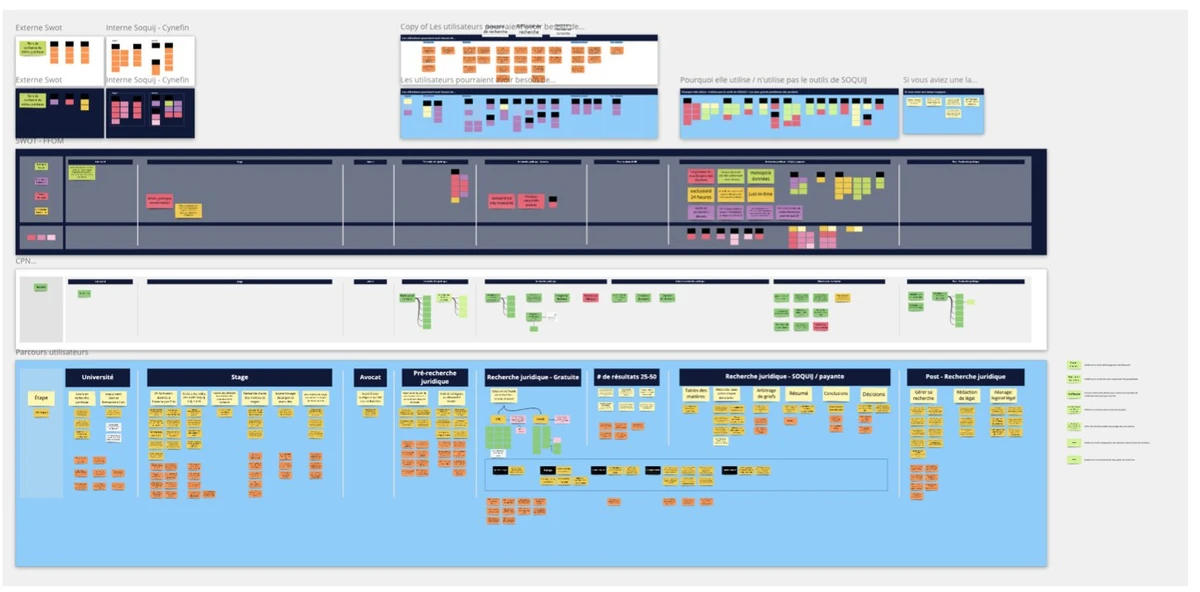
Overview of the map to map board: SOQUIJ's SWOT and Cynefin on top, the users' research journey from law school to after the search below, covered in sticky notes
In 2021, before ChatGPT, the conclusion was already clear: clean up the data first. AI comes next.
SOQUIJ publishes Québec's court decisions and legal information. Lawyers, notaries and paralegals rely on it every day. In 2021, its tools were showing their age.

SOQUIJ wanted to understand what law firms really need when they look for legal information, and where its own tools got in the way. Between February and September 2021, I facilitated framing workshops with SOQUIJ's product team, a discovery workshop with a large law firm's research team, seven user interviews, an alignment workshop, a quantitative survey, and interviews with buyers at large firms.

The content was still SOQUIJ's strength, especially in labour law, and its reputation with senior lawyers was excellent. The friction was everywhere else.
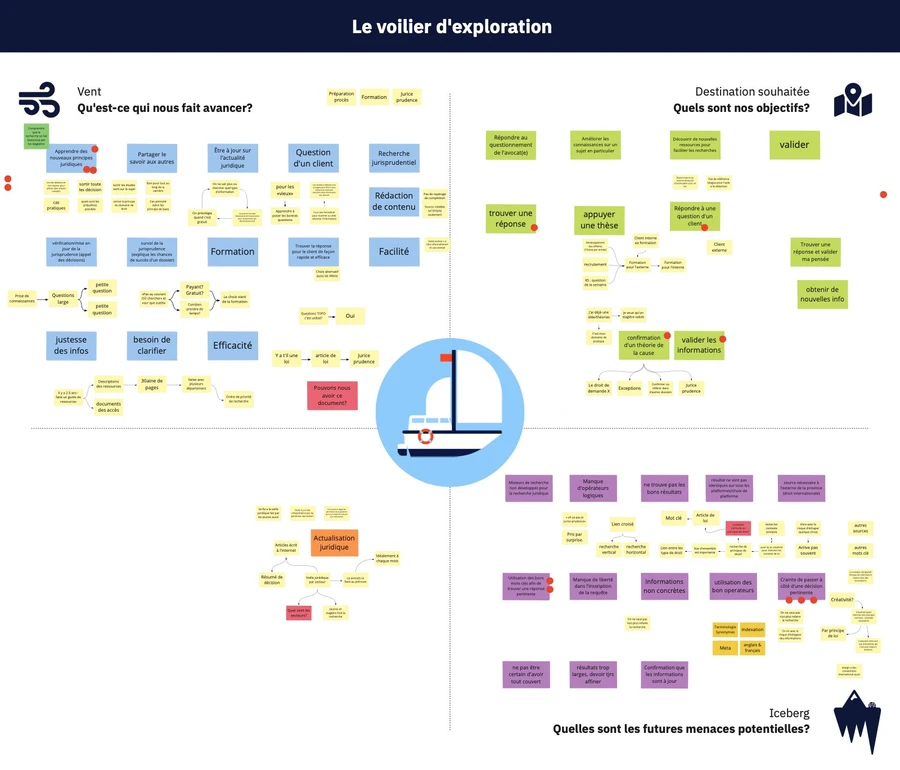
The sailboat board: what pushes legal research forward, where it wants to go, and the icebergs ahead, including terminology, synonyms, indexing and metadata
The sailboat. Among the icebergs: terminology, synonyms, indexing, metadata.
Framed it with SOQUIJ. A SWOT and a Cynefin to sort what was wrong with the digital tools, and why.
Met a law firm's researchers. A sailboat, a client selection ladder and 10x10 writing with the people who search every day.
Interviewed users. From interns to senior lawyers, then drew their research journey, from law school to after the search.
Laid one map on the other. A map to map: SOQUIJ's reality over the users' journey, to see exactly where the problems hit.
Surveyed, then prioritized. A quantitative survey, interviews with buyers, and every need on an impact and complexity matrix.

What the research showed

Searching is stressful

Finding the right terms, refining results, and the fear of missing the one decision that matters. A search could take 15 minutes or 3 hours.

The pricing fought the tool

Users paid for documents that turned out irrelevant, and knew their usage set next year's price. So they started their searches in free tools.

Too many places to look

Each search engine had its own commands and its own login. Users wanted one place and one way to search.

The conclusion

Clean the data, then AI

In 2021, before large language models reached the market, the recommendation was already clear. To use AI one day, SOQUIJ first had to decide which kind of AI could help, then structure its databases for it.

The research showed why. Court records came back as images of text. Naming differed from one database to the next. Terminology, synonyms and metadata were missing, so decades of content stayed invisible to search and unusable by machines. Clean the data, rebuild the information architecture, and the content becomes ready for AI.
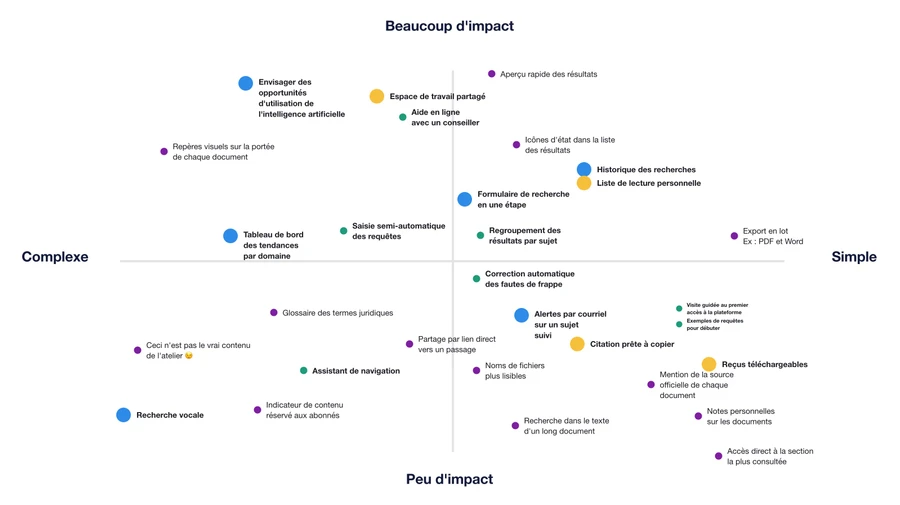
Impact and complexity matrix of the needs raised in the workshops and survey, with preparing for artificial intelligence in the high impact, complex corner; the other labels are anonymized
Every need, by impact and complexity. Preparing for AI sat top left: high impact, complex, a project of its own. The other labels are anonymized.

Where SOQUIJ is today

Public milestones from SOQUIJ's own reports. Their work, not ours, in the direction the 2021 conclusion pointed to.

  1. Summer 2024SOQUIJ's editorial processing chain gets a major technology upgrade: a new system now holds all the data of the decisions it publishes.
  2. 2024-25After two decades of attempts, an AI assistant, using extractive AI, aims to help SOQUIJ's legal advisors analyze case law, so they can produce more and better decision summaries.
  3. February 2025SOQUIJ unveils its Charter for the ethical and responsible use of AI.
  4. 2025-2029The new strategic plan: become the reference for judicial and legal data, and a leader in responsible, ethical AI in the legal ecosystem.
  5. March 2025More than 2.2 million decisions in Recherche juridique, more than 425,000 decision summaries, and 53,247 SOQUIJ users.
Quick wins, long-term projects, and one conclusion ahead of its time
A prioritized list of fixes for the search tools, a plan for the bigger projects, and the advice that mattered most: before AI, clean and structure the data.

Credits

Facilitation and UX research
Jean-Sébastien Daigle
Client
SOQUIJ